


Free shipping within Austria from € 99
Free shipping to Germany from € 120
Introducing Umbria
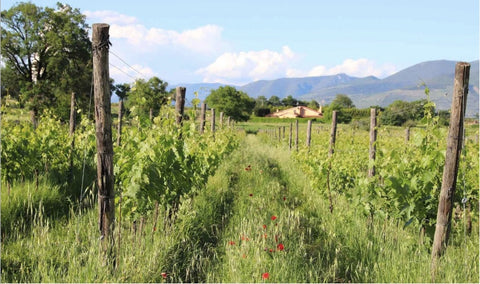
Umbria is a blessed land, and not just since Assisi became an epicenter of global pilgrimage culture.
The landscape initially mirrors that of neighboring Tuscany almost exactly, before becoming wilder and more mountainous as one moves south and east. Every few kilometers, you’ll come across ancient villages which—once you’ve left the orbit of Assisi and Spoleto—are rarely overrun and whose photogenic townscapes almost always include a trattoria where you can eat excellently for very little money.
There are, however, two things you’ll look for in Umbria in vain: the sea, and more than a handful of winemakers producing truly outstanding wines. The former is unlikely to change any time soon; in the latter case, at least, there is some hope.
Missteps
Umbria is an ancient wine-growing region, and it’s likely that a few hundred years ago—and even a few decades back—its wines were generally more interesting than they are today. In the last three decades, however, several factors have combined to rob the wines of originality and character.
First, Tuscany’s winemaking aristocracy discovered the region and, along with a few influential journalists, branded it as the "Burgundy of Italy." Chardonnay—and a bit of Pinot Noir—was planted, the wines were aged in new barriques, and thus these producers proved, if nothing else, that Burgundy lies a thousand kilometers away.
Even worse—and almost irreversible—was the industrialization of agriculture in Orvieto, Umbria’s most famous wine region. In recent decades, vast quantities of uninspired wine have been mass-produced there for the world’s supermarkets. So unless you’re going to visit the stunning cathedral of the town by the same name, there’s little reason to go.
A final fact that, until recently, gave good reason to steer well clear of Umbrian wines was the excessive concentration imposed on the high-quality Sagrantino grape. Already naturally rich in tannins and alcohol, the wines were pushed even further using every technological trick available: harvested as late as possible, extended maceration, and aging in new oak. The already opulent wines thus mutated into testosterone-soaked heavyweights that could knock out even seasoned drinkers after just one bottle. None of these three developments did the region’s viticultural identity any favors.
Sagrantino
In recent years, however, things have started to change. Orvieto is still a qualitative wasteland (we can’t currently think of a single producer there whose wines we enjoy drinking), but things look a bit more promising in Montefalco, the stronghold of Sagrantino.
The credit goes to a small handful of winemakers who cultivate their vines organically on the gently sloping hills of the region, show little interest in the over-technologized styles of their peers, and instead rely on more traditional and much better-suited methods for the grape: spontaneous fermentation, moderate maceration times, and long aging in used barrels.
Our favorite Sagrantinos come from Francesco Mariani of Raína. His wines are full of power and intensity, yet he brings them into beautiful balance with precision and a clear, flowing drinkability.
Sangiovese & Trebbiano Spoletino
If the pure Sagrantino is still too overpowering for your taste, you can also try the supposedly simpler (and much more affordable) versions, typically blended with Sangiovese and sold under the name Montefalco Rosso.
Sangiovese is also Umbria’s second truly important red variety. Especially in the north near Perugia, several—often young—winemakers produce structured, lively wines that are approachable even in their youth. With no entrenched reputation to protect, these producers have embraced experimentation. As a result, Umbria has, in recent years, given rise to a handful of winemakers who are succeeding with distinctive, exciting wines that defy the mainstream.
Beyond Sagrantino and Sangiovese, Umbria—particularly Montefalco—offers another highly intriguing variety: Trebbiano Spoletino. In the hands of Francesco Mariani, it is transformed into a wine that combines a broad spectrum of fruit and herbal aromas with body and elegance—and it ages beautifully as well.
Wines from the Region
-
Campo di Colonnello 2024
Vendor:RainaRegular price €16,90 EURRegular priceUnit price per -
Campo di Raina 2021
Vendor:RainaRegular price €27,90 EURRegular priceUnit price per -
 Sold out
Umbria Grechetto IGT 2024
Vendor:RainaRegular price €13,90 EURRegular priceUnit price per -
Rosso della Gobba 2023
Vendor:RainaRegular price €13,90 EURRegular priceUnit price per -
Le Campette 2022
Vendor:RainaRegular price €16,90 EURRegular priceUnit price per -
Le Pretelle 2020
Vendor:RainaRegular price €39,90 EURRegular priceUnit price per